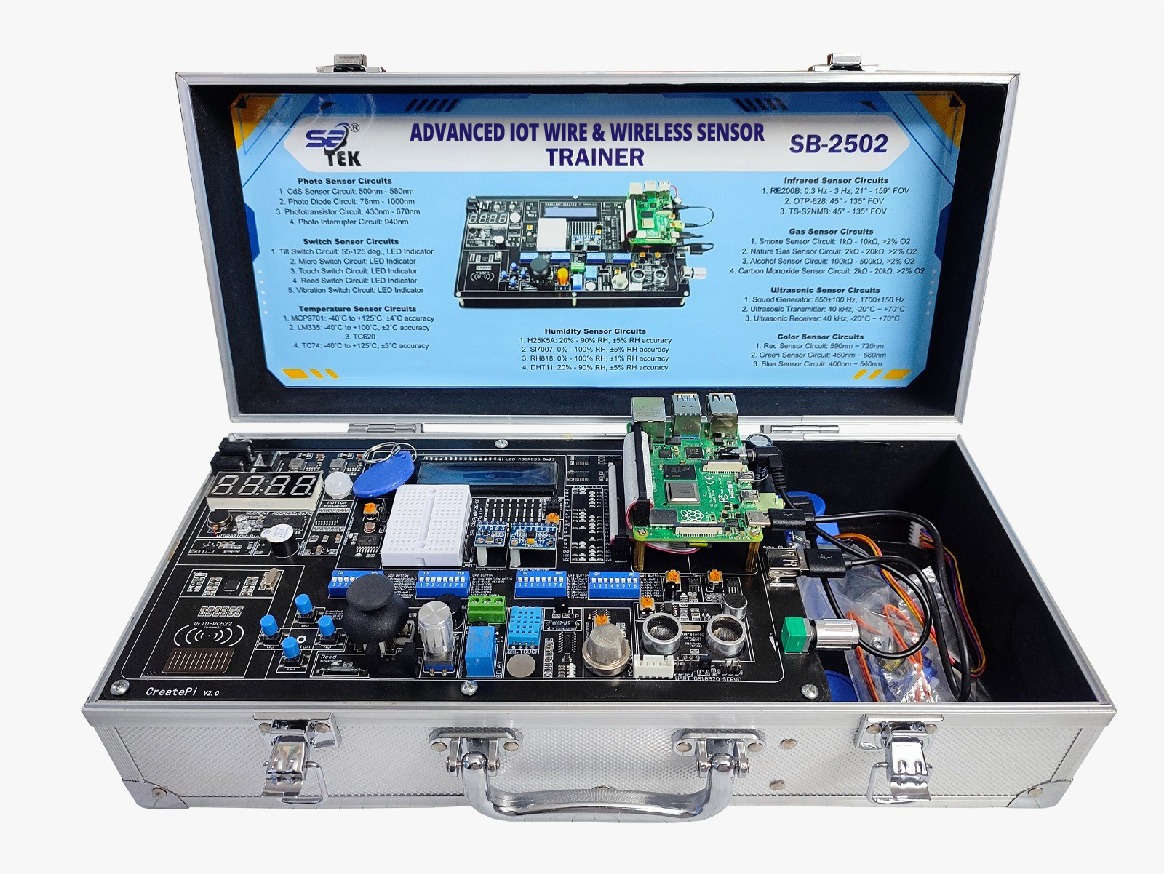
OVERVIEW: The IOT Wire & Wireless Trainer Board is an all-in-one embedded systems learning platform built around the Raspberry Pi. It consolidates more than 30 industry-standard sensors, actuators, and communication modules onto a single, robust PCB that mounts directly onto the Raspberry Pi's 40-pin GPIO header — eliminating the wiring errors and breadboard clutter that typically slow down hands-on learning. Each module is pre-wired to a dedicated GPIO pin and isolated by a bank of labelled DIP switches, allowing learners to safely enable exactly the circuit they are working with. Paired with the included 5" HDMI touch display and a structured curriculum of 35+ guided experiments, the Trainer transforms any Raspberry Pi 4B into a complete embedded systems classroom — suitable for STEM education, maker workshops, and self-directed learning alike. Key Features ? 30+ onboard sensors and actuators spanning digital, analog, I2C, SPI, and 1-Wire interfaces ? Conflict-free experimentatio
Technical Specifications
Specification Detail
Compatible Boards Raspberry Pi 4 Model B (recommended); Pi 2/3 Model B/B+
GPIO Interface 40-pin header, direct mount
Onboard Modules 30+ sensors, actuators & displays
Communication Protocols GPIO Digital I/O, PWM, I2C, SPI, 1-Wire, Analog (via PCF8591 ADC)
Display 5" HDMI touchscreen with stand and dedicated power input
Input Devices 4x independent push buttons, 2.4GHz wireless keyboard/mouse receiver
Power Input 12V DC via dedicated power interface, onboard power switch
Prototyping Area Integrated small-form breadboard
Module Isolation 4 x 8-bit DIP switch banks (UX1–UX4)
Recommended IDE Thonny (Python 3)
Recommended Libraries RPi.GPIO, gpiozero, smbus2, spidev, adafruit-blinka
Documentation Included Full GPIO/I2C pin reference and 35+ experiment guide
Complete Sensor & Module Inventory
Every module below is permanently mounted on the trainer board and individually addressable through its labelled DIP switch.
Digital Output Modules
Module Interface Typical Application
LED Indicator Module GPIO Digital Out Visual status / signaling
Active Buzzer GPIO Digital Out Fixed-tone audible alert
Passive Buzzer GPIO PWM Variable-tone / melody output
Vibration Motor GPIO Digital Out Haptic feedback
Relay Module GPIO Digital Out High-power load switching
RGB LED Module GPIO PWM (3-ch) Full-colour lighting effects
Micro Servo Motor GPIO PWM Precision angular positioning
Stepper Motor + Driver GPIO Digital Out (4-ch) Precision rotational control
Digital Input Modules
Module Interface Typical Application
4x Independent Push Buttons GPIO Digital In User input / navigation
Sound Sensor GPIO Digital In Clap / noise-triggered detection
DHT11 Temperature & Humidity GPIO Single-Wire Climate monitoring
PIR Motion Sensor GPIO Digital In Human presence detection
HC-SR04 Ultrasonic Sensor GPIO Digital I/O (2-ch) Non-contact distance ranging
Capacitive Touch Sensor GPIO Digital In Touch-activated switching
Tilt / Vibration Switch GPIO Digital In Orientation change detection
IR Remote Receiver GPIO Digital I/O Infrared remote-control input
Flame Sensor GPIO Digital In Fire / open-flame detection
Digital Smoke Sensor GPIO Digital In Smoke / gas presence alert
IR Obstacle Avoidance Sensor GPIO Digital In Robotics collision avoidance
U-Slot Photoelectric Sensor GPIO Digital In Beam-break / speed counting
Hall Effect Sensor GPIO Digital In Magnetic field detection
Digital Rotary Encoder GPIO Digital In (3-ch) Precision rotary input
Reed Switch GPIO Digital In Magnetic proximity sensing
I2C & 1-Wire Modules
Module Interface Typical Application
Digital Ambient Light Sensor I2C (0x5C) Precision lux measurement
16x2 Character LCD I2C (0x21) Text / data readout
4-Digit 7-Segment Display I2C (0x70) Numeric readout
BMP180 Barometric Sensor I2C (0x77) Air pressure & altitude
MPU6050 6-Axis IMU I2C (0x68) Motion, tilt & gyroscope sensing
DS18B20 Digital Thermometer 1-Wire High-accuracy temperature logging
SPI Modules
Module Interface Typical Application
RC522 RFID Reader/Writer SPI Contactless card identification
8x8 LED Dot-Matrix Display SPI Graphics & scrolling text
Analog Modules (via PCF8591 ADC)
Module Interface Typical Application
Dual-Axis PS2 Joystick Analog (AD/DA) Two-axis analog input
Photoresistor (LDR) Module Analog (AD/DA) Ambient light level sensing
Rotary Potentiometer Analog (AD/DA) Variable analog input
NTC Thermistor Module Analog (AD/DA) Analog temperature sensing
Additional Onboard Hardware & Accessories
Component Purpose
Raspberry Pi Mounting Bay Fits Raspberry Pi 4B and compatible variants
4 x 8-Bit DIP Switch Banks (UX1–UX4) Isolates each module for conflict-free experimentation
Small Prototyping Breadboard For custom circuits alongside the fixed modules
2.4GHz Wireless Keyboard/Mouse Receiver Untethered control of the connected display
7" HDMI Touch Display + Stand Integrated visual output and touch input
40-Pin Ribbon Cable & GPIO Breakout Reliable, keyed GPIO connection
Dedicated Power Input (12V) with On/Off Switch Stable power delivery to board and display
Headphone Output Jack Audio output for multimedia projects
Experiment & Exercise List
The CreatePi curriculum comprises 35 guided exercises, sequenced from foundational GPIO control through advanced multi-protocol sensing. Each exercise maps to a specific onboard module and a documented learning objective.
No. Exercise Category Learning Objective Level
01 Blinking an LED Digital Output Introduce GPIO.OUT and timed signal control Beginner
02 Active Buzzer Alert Digital Output Generate a fixed-tone audible signal on demand Beginner
03 Passive Buzzer Melody Digital Output Use PWM to generate variable-frequency tones Beginner
04 Vibration Motor Feedback Digital Output Trigger haptic feedback from a GPIO event Beginner
05 Relay-Controlled Load Switching Digital Output Safely switch a higher-power circuit from GPIO Intermediate
06 RGB LED Color Mixing Digital Output Blend three PWM channels to produce custom colors Intermediate
07 Servo Angle Positioning Digital Output Drive a servo to precise angles using PWM duty cycle Intermediate
08 Stepper Motor Rotation Digital Output Sequence four coils for controlled step rotation Intermediate
09 Four-Button Navigation Pad Digital Input Read multiple digital inputs with pull-up resistors Beginner
10 Sound-Activated Trigger Digital Input Detect clap/noise events via a comparator sensor Beginner
11 Temperature & Humidity Logging Digital Input Poll a single-wire DHT11 sensor and handle read errors Intermediate
12 Motion-Activated Alert Digital Input Combine a PIR sensor with an output device Beginner
13 Ultrasonic Distance Measurement Digital Input Calculate distance from echo pulse timing Intermediate
14 Touch-Activated Switching Digital Input Use a capacitive sensor as a digital trigger Beginner
15 Tilt & Orientation Detection Digital Input Detect physical orientation change events Beginner
16 Infrared Remote Signal Capture Digital Input Capture and interpret IR remote pulses Advanced
17 Flame Detection Alarm Digital Input Build a fire-detection safety circuit Beginner
18 Smoke Detection Alert Digital Input Build a smoke-detection safety circuit Beginner
19 Obstacle-Avoidance Logic Digital Input Foundation exercise for autonomous robotics Intermediate
20 Beam-Break Object Counting Digital Input Count pass-through events with a slot sensor Intermediate
21 Magnetic Field Detection Digital Input Use a Hall sensor for contactless proximity sensing Beginner
22 Rotary Encoder Value Counter Digital Input Track direction and magnitude of rotary input Advanced
23 Reed Switch Door Sensor Digital Input Build a magnetic door/window open-close sensor Beginner
24 Precision Ambient Light Logging I2C Communicate with an I2C light sensor and convert to lux Intermediate
25 Text Output on I2C LCD I2C Send formatted text/data to a character display Intermediate
26 Numeric Readout on 7-Segment I2C Drive a multiplexed 7-segment display over I2C Intermediate
27 Barometric Pressure & Altitude I2C Read and calculate altitude from air pressure Intermediate
28 6-Axis Motion Sensing I2C Read accelerometer and gyroscope data simultaneously Advanced
29 High-Accuracy Temperature Logging 1-Wire Interface with a 1-Wire digital thermometer Intermediate
30 RFID Card Identification SPI Read unique card IDs and stored data over SPI Advanced
31 Dot-Matrix Graphics & Text SPI Render pixels and scrolling text on an LED matrix Advanced
32 Analog Joystick Input Analog / ADC Read two analog channels through an external ADC Intermediate
33 Light-Level Analog Sensing Analog / ADC Convert analog light readings to usable values Intermediate
34 Potentiometer-Based Control Analog / ADC Use a variable resistor as an analog input Beginner
35 Analog Temperature Sensing Analog / ADC Convert thermistor resistance to temperature Advanced
Learning Outcomes
Learners who complete the full CreatePi curriculum will be able to:
? Configure and control GPIO pins for digital input and output
? Generate and modulate PWM signals for motors, servos, and audio
? Communicate with peripheral devices over I2C, SPI, and 1-Wire protocols
? Read and condition analog signals via an external ADC
? Diagnose and resolve common hardware wiring and addressing conflicts
? Design simple multi-sensor systems such as alarms, environmental loggers, and basic robotics controllers
Ordering Information
The Trainer Board is available as a complete kit, including the sensor board, 5" HDMI touch display, wireless keyboard/mouse receiver, power supply, and full documentation set. Raspberry Pi boards and microSD cards may be purchased separately or bundled on request.
For pricing, bulk classroom licensing, or distributor inquiries, please contact your sales representative or authorized reseller.